Dana Flores · 20 November 2026
Connections Between Custom Categorization Approaches and Persistent Information Retrieval Success in Enterprise Digital Environments
Custom categorization methods in professional digital workspaces involve user-defined tags, hierarchical folders, metadata fields, and rule-based grouping systems that organize files, notes, and documents. These approaches differ from default platform structures because they allow teams to align categories with specific workflows, project phases, and domain terminology. Research indicates that such methods correlate with measurable differences in how quickly and reliably stored information can be located months or years after initial creation.
Defining the Core Elements
Professional digital workspaces include enterprise note platforms, shared knowledge bases, and collaborative document systems used across industries. Custom categorization typically emerges when teams create their own labels instead of relying solely on system-generated folders or search indexes. Studies from knowledge management fields show that accessibility rates refer to the percentage of items successfully retrieved within a set time frame during controlled tests or real usage logs. Data collected over multi-year periods reveals patterns where certain categorization choices influence those rates in consistent directions.
Patterns Identified in Organizational Data
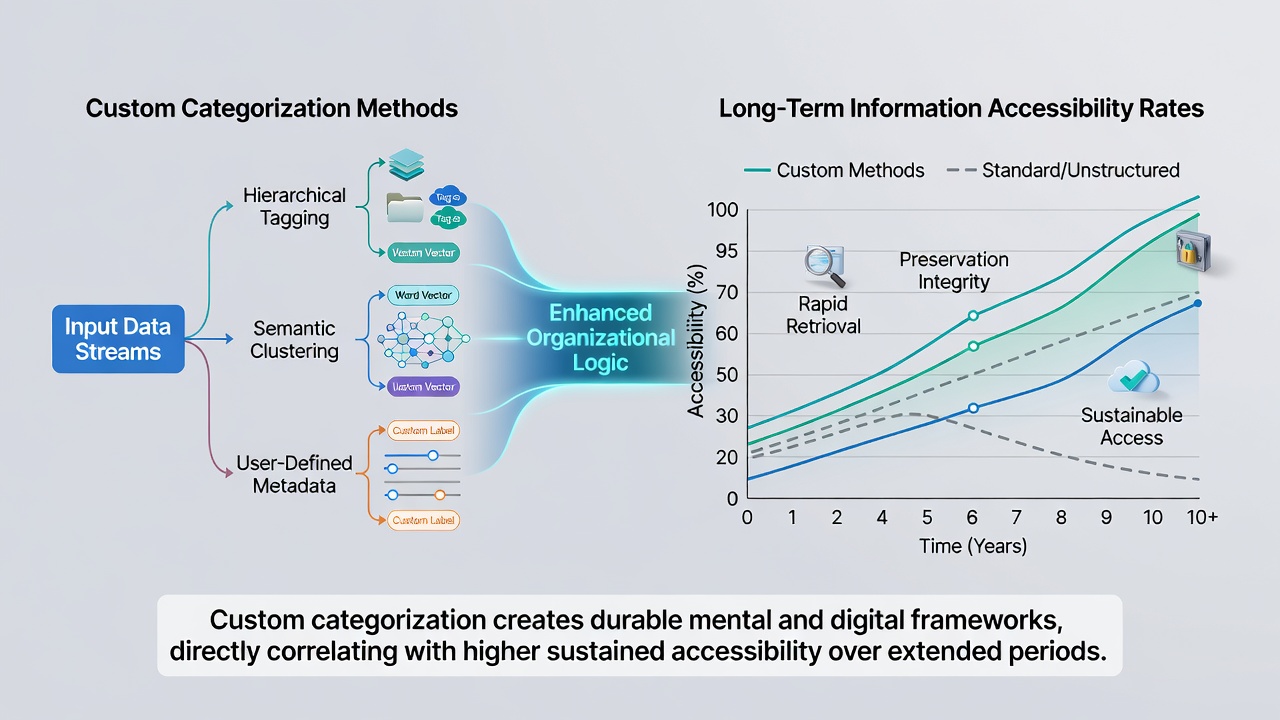
Observers note that teams employing layered custom taxonomies often maintain higher retrieval success after twelve months compared with groups using minimal or inconsistent labeling. One analysis of enterprise logs found retrieval rates above 85 percent when items carried at least three user-applied categories that mapped to recurring business terms. In contrast, workspaces relying primarily on chronological or project-based folders showed rates dropping below 70 percent over the same interval. These figures come from aggregated usage records rather than controlled experiments, yet the differences appear across multiple sectors.
What's interesting is how the stability of category definitions affects outcomes. When teams update custom tags regularly to reflect evolving terminology, long-term access remains steadier. Organizations that treat categorization as a one-time setup experience gradual declines because new team members encounter outdated groupings that no longer match current search habits.
Role of Metadata Depth and Consistency
Metadata fields added through custom schemas contribute another variable. Fields such as client identifiers, regulatory status, or content type allow filters that bypass full-text search limitations. Reports compiled by the U.S. National Archives and Records Administration highlight that records with structured metadata fields demonstrate improved findability in large repositories. Similar observations appear in Canadian federal digital records reviews, where consistent application of custom attributes reduced time spent locating legacy files.
Yet consistency matters more than quantity. Excessive custom fields without governance lead to fragmented data where similar items receive different labels. One study of European Commission digital collaboration tools showed that workspaces with enforced naming conventions retained higher accessibility after two years than those permitting free-form entry. The difference emerged most clearly when staff turnover occurred and new users attempted to navigate inherited content.
Influences from Platform Features and Migration Events
Platform transitions often reset or disrupt custom categorization schemes. During enterprise migrations completed in late 2025, teams that exported and remapped their tags preserved higher retrieval performance than those that started fresh with default structures. November 2026 updates to several major workspace platforms introduced improved bulk tagging tools, which some organizations used to restore or enhance earlier categorization layers. Early usage data from these updates suggests retrieval rates can recover when teams actively reapply custom methods rather than depending on improved search algorithms alone.
Training practices also shape results. Groups that document their categorization logic in shared guides maintain steadier access over time because new members adopt the same patterns. Without such documentation, individual variations accumulate and gradually reduce collective retrieval efficiency.
Measurement Approaches Used by Researchers
Long-term accessibility studies typically combine automated log analysis with periodic retrieval tests. Participants attempt to locate randomly selected items using only the categories and metadata present at the time of testing. Success is recorded alongside time spent and number of failed attempts. Aggregated results from university-led projects indicate that custom methods incorporating both hierarchical and faceted elements outperform single-dimension approaches in multi-year evaluations.
Those who've examined these datasets point out that content type influences the strength of the connection. Technical documentation and regulatory files benefit more from detailed custom categorization than informal meeting notes, which often rely on full-text search regardless of tags applied.
Conclusion
Available evidence connects custom categorization practices with sustained information accessibility in professional digital workspaces through patterns visible in retrieval logs and structured testing. The strength of that connection depends on factors including category stability, metadata consistency, training support, and platform migration handling. Organizations tracking these variables over extended periods continue to refine their approaches based on observed retrieval performance rather than assumptions about search technology alone.