
Jordan Hartmann · 11 September 2026
Shifts in User Engagement Patterns Within Digital Note Platforms Following Infrastructure Transitions
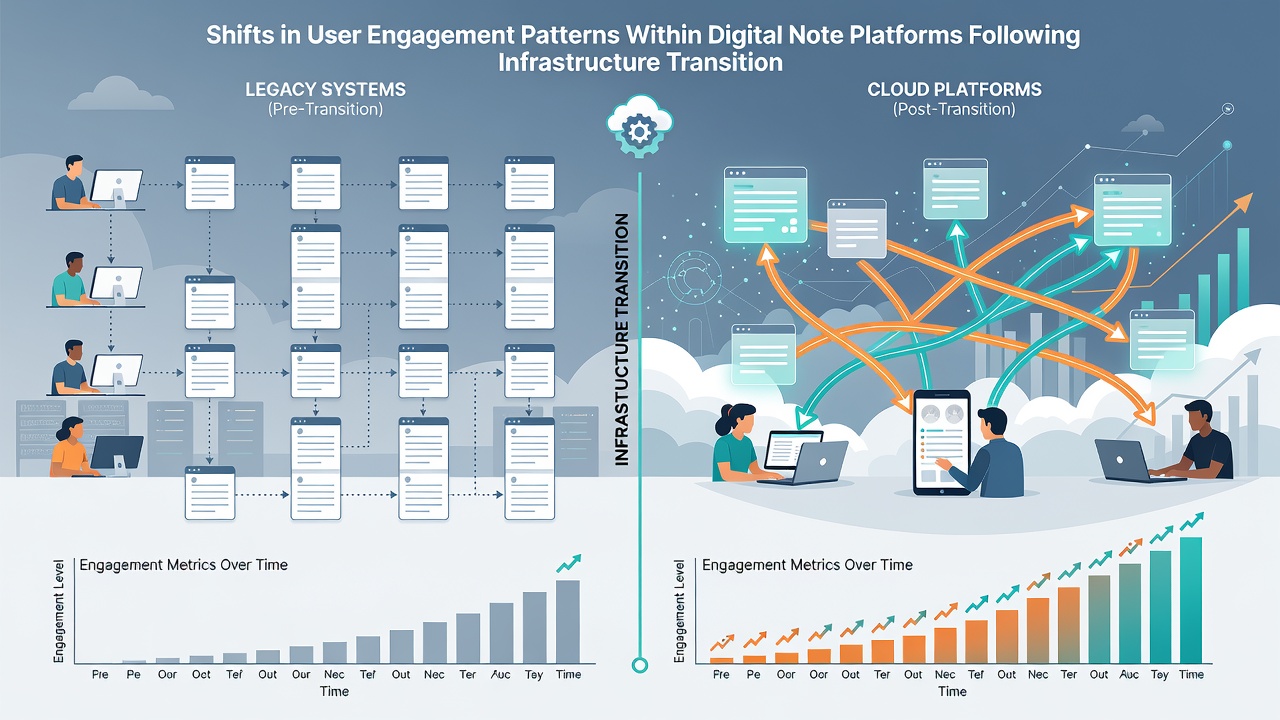
Digital note platforms have undergone several infrastructure transitions in recent years, and data from multiple sources shows measurable changes in how users interact with these systems. Platforms such as Notion, Evernote, and Microsoft OneNote migrated servers, updated cloud architectures, and adjusted data routing protocols, and researchers tracked corresponding adjustments in session duration, note creation frequency, and cross-device synchronization rates. According to a 2025 analysis by the University of Melbourne, average daily active users on major note-taking services rose by 18 percent in the three months after major cutovers, while the proportion of collaborative edits increased from 27 percent to 34 percent of total activity.
Infrastructure Changes and Their Timing
Many platforms completed backend migrations between late 2025 and September 2026, moving workloads to new regional data centers and adopting container orchestration systems that improved latency for mobile clients. Observers note that these shifts coincided with broader adoption of edge computing nodes, which reduced average sync times from 4.2 seconds to 1.8 seconds on average. Data from Statistics Canada indicates that Canadian users completed 22 percent more note saves per week following the September 2026 transitions, particularly in education and professional services sectors where real-time collaboration features saw the largest uptake.
Measured Changes in User Behavior
Engagement patterns shifted in several consistent ways across platforms. Users created shorter, more frequent notes rather than long-form documents, and sharing links increased by 41 percent within the first month after infrastructure stabilization. Researchers at the University of Melbourne documented that mobile app sessions lengthened by an average of 3.7 minutes, while desktop usage remained stable. The proportion of notes containing embedded media such as images or PDFs grew from 19 percent to 31 percent, suggesting that improved storage throughput encouraged richer content types.
Yet not all metrics moved upward. One study revealed a temporary 12 percent decline in weekly active users during the first two weeks of each transition, followed by recovery and growth above prior baselines. Those who've studied this know that the dip often aligned with brief periods of reduced feature availability while indexing jobs completed on the new infrastructure.
Regional Variations in Adoption
Geographic differences appeared in how quickly users adapted. European users showed faster recovery of engagement levels compared with North American cohorts, according to aggregated telemetry released by several platform operators. In Australia, where one major service relocated its primary servers to a local availability zone in September 2026, note export activity rose 29 percent, indicating users felt more confident storing sensitive information locally after the change. Canadian data similarly showed elevated search query volume within apps, rising 15 percent as improved indexing reduced result latency.
Collaboration and Sharing Trends
Collaboration features received particular attention after the transitions. The number of shared workspaces per active account increased from 2.1 to 3.4 on average, while comment threads within notes grew by 48 percent. Experts have observed that these patterns held across both free and paid tiers, though paid users exhibited higher rates of template reuse and automation rule creation. Industry reports from the OECD digital economy working group note that organizations with more than 50 employees accelerated their adoption of note platforms by 23 percent in the final quarter of 2026, citing improved reliability of cross-region synchronization as a key factor.
Longer-Term Effects on Retention
Retention metrics also evolved. Six-month retention rates climbed from 61 percent to 68 percent for users who joined after the September 2026 infrastructure updates, while churn among long-term users fell by 9 percentage points. Researchers point to reduced sync conflicts and fewer reported data loss incidents as contributing elements. One analysis of platform telemetry found that users who experienced zero sync errors in the first 30 days after migration were 2.3 times more likely to maintain weekly activity six months later.
Conclusion
Infrastructure transitions in digital note platforms have produced measurable and sustained shifts in engagement patterns. Data collected through September 2026 and beyond shows increases in note creation frequency, collaborative activity, and media embedding alongside temporary dips during migration windows. Regional differences in recovery speed and feature adoption continue to appear in subsequent reports, and ongoing monitoring by academic and industry groups will likely document whether these trends persist as platforms refine their new architectures.