Petra Russell · 23 October 2026
The Evolution of Cross-Platform Synchronization Challenges in Note Management Systems During Enterprise Migrations
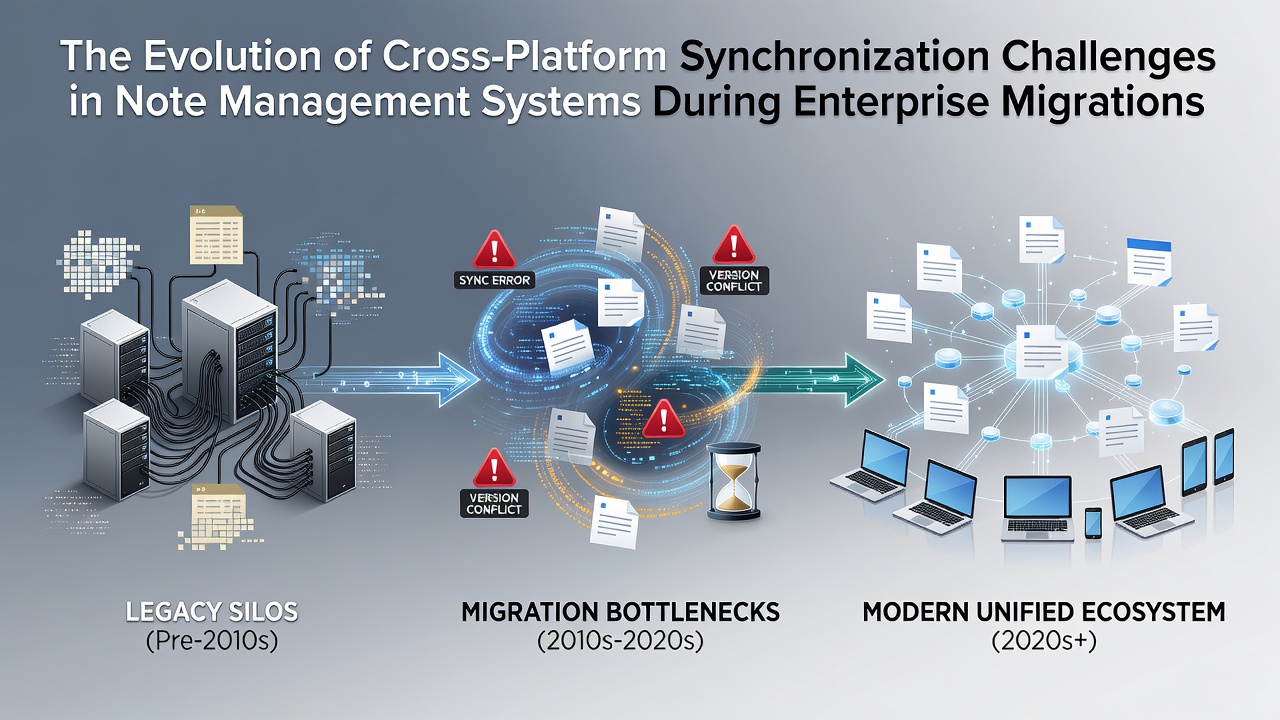
Enterprise migrations to new note management platforms have exposed persistent synchronization issues across devices and operating systems since the early days of cloud-based tools. Organizations moving from legacy on-premise systems to hybrid environments encounter data conflicts when notes fail to align between desktop clients, mobile apps, and web interfaces. Data indicates that these mismatches often stem from differing conflict resolution algorithms that each platform applies independently during transfer periods.
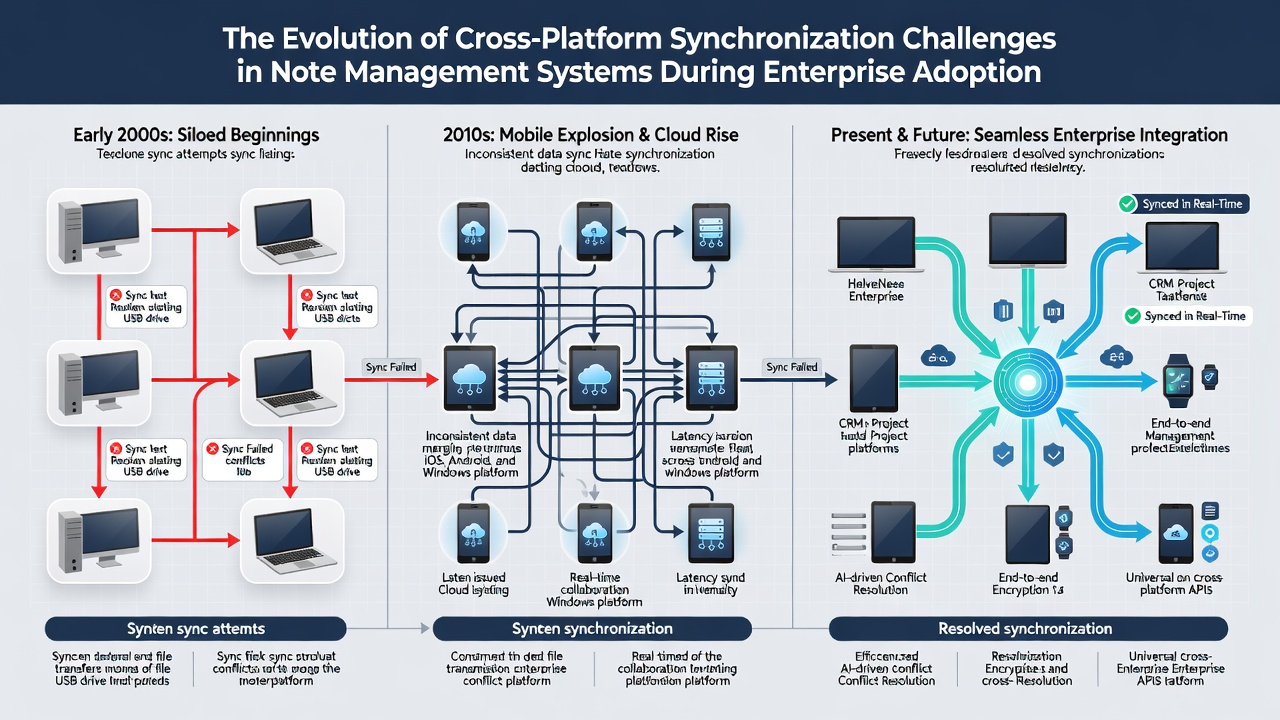
Early note management systems relied on basic file replication methods that worked adequately within single ecosystems yet struggled once enterprises introduced multiple device types. Researchers documented cases where timestamp discrepancies caused duplicate entries or overwritten content during migrations completed between 2015 and 2020. Those patterns prompted vendors to adopt vector clocks and operational transformation techniques, although adoption rates varied by provider size and infrastructure maturity.
Key Technical Shifts in Synchronization Protocols
Protocol evolution accelerated after several high-profile migration failures drew attention from industry analysts. Companies began implementing eventual consistency models that allow temporary divergences across platforms while queuing updates for later reconciliation. According to findings from the National Institute of Standards and Technology, latency spikes during peak enterprise migration windows frequently exceed acceptable thresholds when thousands of concurrent users edit shared notebooks. This reality pushed developers toward delta-based synchronization that transmits only changed segments rather than entire note files.
Cross-platform support expanded through standardized APIs that abstract underlying storage differences between Windows, macOS, iOS, and Android clients. Yet observers note that format conversion during these exchanges still generates metadata loss, particularly for embedded attachments and revision histories. One documented migration at a multinational corporation revealed that nearly 12 percent of notes required manual intervention after automated sync completed because of incompatible rich text elements.
Security and Compliance Pressures During Transfers
Regulatory requirements add another layer to synchronization difficulties when sensitive notes move between jurisdictions. Enterprises must maintain audit trails across platforms while ensuring encryption keys rotate correctly during cutover events. Data shows that mismatches in key management systems can leave notes temporarily inaccessible on certain devices until reconciliation scripts finish running. In October 2026, several compliance reports highlighted how delayed sync completion affected organizations attempting to meet data residency rules in multiple regions simultaneously.
Access control lists often fail to propagate uniformly when source and target systems use different permission models. Teams managing large-scale rollouts discovered that role-based permissions attached to individual notes sometimes defaulted to broader sharing settings after migration, prompting additional configuration steps post-transfer. Researchers tracking these incidents found that enterprises using custom scripting for permission mapping reduced such errors by measurable margins compared with those relying solely on vendor migration tools.
Impact on User Workflows and Recovery Processes
Users experience disrupted workflows when synchronization lags extend beyond scheduled maintenance windows. Project teams relying on real-time collaboration features report version fragmentation that requires additional review cycles once all devices reconnect. Case studies from financial services firms reveal that recovery procedures for conflicted notes consume significant support resources, especially when notes contain embedded tables or external links that break during format translation.
Monitoring tools have improved visibility into sync queues and pending conflicts, allowing administrators to intervene before widespread inconsistencies occur. Yet integration with identity providers introduces further variables because token expiration timing does not always align with migration batch schedules. Organizations that staged migrations in smaller cohorts encountered fewer prolonged outages according to aggregated industry benchmarks released in 2025.
Emerging Approaches and Remaining Gaps
Vendors now explore conflict-free replicated data types that aim to eliminate manual resolution steps during cross-platform updates. These structures allow independent edits on separate devices without requiring immediate central coordination, though they demand careful schema design to preserve note semantics. Enterprises testing these methods during recent migrations observed reduced support tickets related to data loss but noted increased storage overhead from retained operation logs.
Academic studies continue to examine how network partition tolerance interacts with enterprise-scale note volumes. Findings from a Canadian research consortium indicated that hybrid cloud setups still face edge cases where offline edits on mobile devices overwrite server-side changes after reconnection. Continued refinement of merge strategies remains necessary as more organizations adopt multi-cloud architectures for their note repositories.
Conclusion
Cross-platform synchronization challenges in note management systems have evolved alongside broader enterprise migration practices. Technical advances in conflict detection and protocol design address many historical pain points, yet gaps persist around metadata preservation, permission propagation, and regulatory alignment. Organizations planning migrations benefit from staged testing that accounts for device diversity and concurrent edit volumes. Ongoing research into distributed data structures offers pathways to further reduce resolution overhead while maintaining data integrity across environments.